

PSIM and PIAM are both used in the physical security and infrastructure space. And because both bring different systems and information together, it’s easy to see why the two can sometimes be confused.
But they solve very different layers of the physical security challenge.
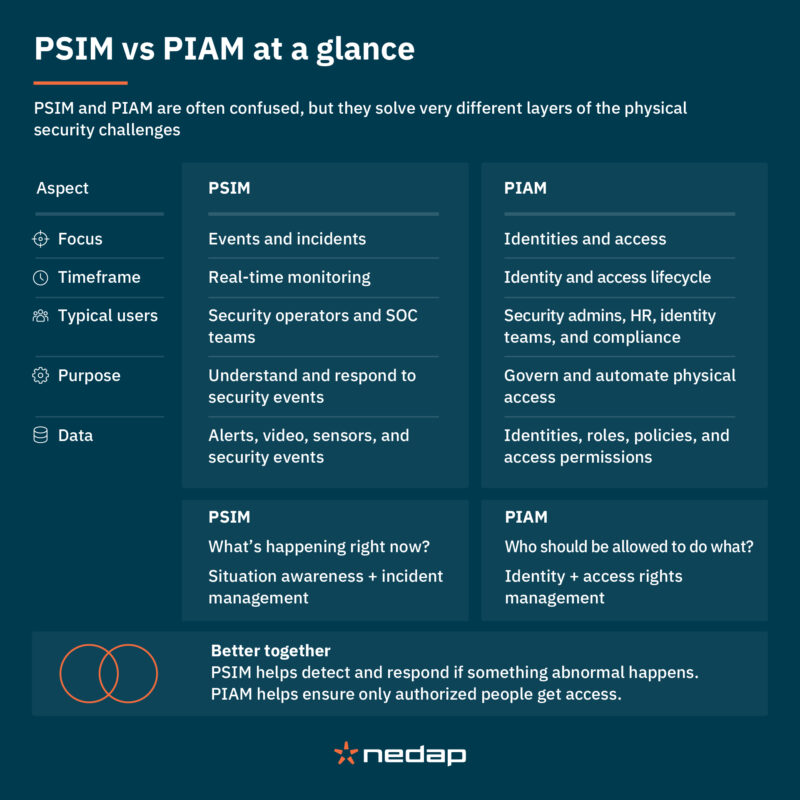
One simple way to understand the difference is this:
✅ PSIM helps answer: “What’s happening right now?”
✅ PIAM helps answer: “Who should be allowed to do what?”
Understanding that distinction makes it much easier to see where each fits into a physical security environment – and why organizations may use both.
What is PSIM?
PSIM stands for Physical Security Information Management. Its focus is primarily on real-time security operations. PSIMs are often used in control rooms in demanding places operated by security teams and sit on top of multiple physical security systems and bring information from them together. These can include CCTV and video surveillance, access control systems, intrusion alarms, and fire systems.
By bringing these systems into one platform, PSIM gives security operators a more complete view of what is happening across an organization. It can help operators monitor events as they happen, correlate alerts from different security systems, automate response workflows, and respond to incidents more quickly.
For example, if a door is forced open, a PSIM platform could combine that access control event with information from other systems, such as automatically displaying the relevant camera feed to an operator.
Put simply:
PSIM = situational awareness + incident management
What is PIAM?
PIAM stands for Physical Identity and Access Management. Rather than focusing primarily on events, PIAM focuses on people, their identities, and the physical access they should have.
It manages the identity and access lifecycle for different types of people across an organization, including employees, contractors, and visitors.
PIAM can help organizations do the following:
- Manage physical identities,
- Govern who should have access to which locations and areas,
- Automate onboarding and offboarding,
- Apply access policies and approval processes,
- Support compliance and least-privilege principles, and
- Integrate physical access processes with systems such as HR and IAM
PIAM is typically used by people responsible for managing and enforcing an organization’s physical access policies, including who should have access, where, and why. These responsibilities can involve security administrators, information security teams, facilities managers, HR, and other business stakeholders. Unlike PSIM, which is primarily used in security control rooms, PIAM supports access governance and management processes across the organization.
Where PSIM is concerned with what is happening in the physical environment, PIAM answers questions such as:
- Who is this person?
- What should they have access to?
- When should that access begin?
- And when should it end?
Put simply:
PIAM = identity + access rights management
A simple way to think about it
Another way to understand the distinction is to think about keys.
PIAM is like deciding who should receive a key, which doors that key should open, and when they should give it back. PSIM is like the control room monitoring cameras and alarms and helping operators respond when something happens.
The access control system itself can be thought of as the lock: it enforces the access decision when someone presents their credential at the door.
So, in very simple terms:
PIAM governs. Access control enforces. PSIM monitors and supports the response.
Do you need PSIM or PIAM?
It doesn’t necessarily have to be an either/or question.
PSIM and PIAM address different security needs and can complement one another.
PIAM helps make sure the right people receive the right physical access at the right time. PSIM helps security teams understand and respond when something happens across the physical security environment – including situations where someone has valid access but their activity still requires attention.
Consider a contractor who has been approved to work in a particular part of a facility.
PIAM can manage the contractor’s identity, approvals, access rights, and the dates for which that access should be valid. The access control system then enforces those permissions at the door. If an unusual or potentially concerning event occurs, PSIM can bring together information from the relevant security systems to help an operator understand what is happening and take the appropriate action.
Different responsibilities, but potentially part of the same physical security ecosystem.
And that’s ultimately the simplest distinction:
✅ PSIM helps you understand and respond to what is happening.
✅ PIAM helps you govern who should have physical access, where, and when.
Would you like to learn more about this topic? Click right on the button below and we’ll reach out to you!


