

As access points become more decentralised, control often becomes fragmented.
Multiple systems, inconsistent processes, and disconnected environments make it difficult to manage access in a consistent way. At the same time, users expect fast, seamless access wherever they work. Without central coordination, gaps start to appear.
Added to that, many access points without formal access control now need stricter security and governance as threats and compliance demands increase.
The challenge is clear: How do you manage access consistently across distributed locations without compromising security, compliance, or efficiency?
Decentralised access points can lead to decentralised control
Many organisations use separate systems to manage buildings and remote assets, creating gaps between online and offline access control. For example, organisations often use automated digital access control for major hubs but manual workarounds for off-grid sites.
Without centralised access control and governance, risks increase:
- Security policies become inconsistent or aren’t applied consistently.
- Visibility of access events is fragmented, poorly documented, or even non-existent.
- Inefficiencies and admin workloads increase.
One platform, every access point
Managing decentralised access points requires centralised control, applied consistently across every access point. Not just to buildings but to gates, cabinets, and remote infrastructure. Especially as regulatory pressure is increasing, with frameworks like NIS2 demanding control, traceability, and accountability across all access points. Including remote and previously unmanaged locations.
AEOS provides the layer of orchestration needed, acting as the central system for managing identities, authorisations, and access events.
It connects people, workflows, assets, and access methods. And ensures policies are applied automatically across every access point. This means:
- One person can use multiple identifiers such as a mobile pass, physical badge, and biometrics.
- Workflows are linked and streamlined.
- Access rules are defined once and applied instantly across all access points.
- Events from all access points show in real time.
- Clear reporting is available for management, investigations, and compliance.
AEOS ensures consistency, visibility, and control at scale. But how does this work in practice when you have a highly distributed estate?
Extending control with iLOQ
Some access points are in environments without power or network connectivity, often in harsh conditions such as extreme weather or high levels of dust and sand. To ensure centralised access governance stretches to every access point, however challenging, Nedap has partnered with iLOQ.
Together, they’ve created an access control environment that integrates AEOS with iLOQ smart locks, combining centralised intelligence with decentralised execution.
iLOQ’s smart locks need no wiring, batteries or wi-fi connection.
These low-maintenance locks are:
- Opened by a virtual pass on a smartphone.
- Powered by NFC via the smartphone.
- Able to withstand harsh conditions.
This AEOS-iLOQ partnership takes centralised access control to locations where traditional access control can’t reach. AEOS defines, distributes, and tracks access centrally, and iLOQ ensures this centralised control reaches every access point.
More convenient, secure, and compliant
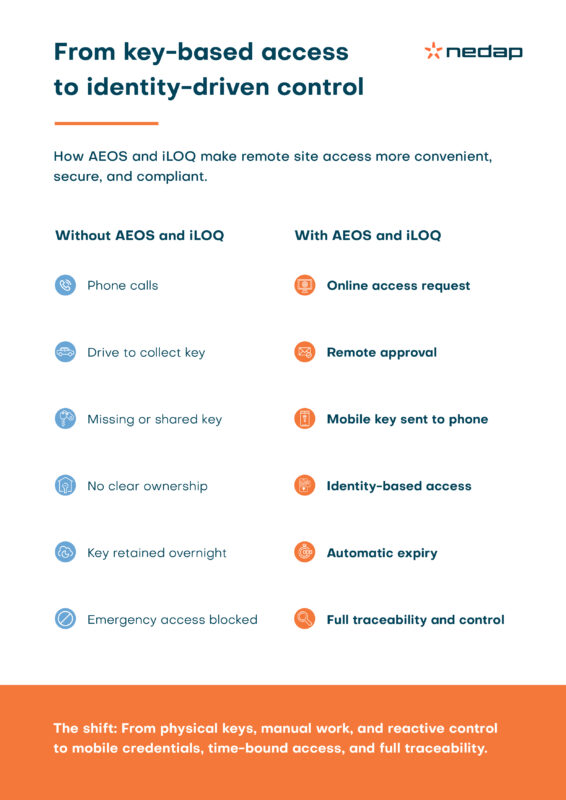
Consider a typical scenario without AEOS and iLOQ.
- A third-party engineer needs to do some maintenance at a remote, unmanned windfarm.
- They arrange the visit over the phone.
- Then they drive an hour to their client’s office to collect a key for the gate.
- The key’s gone missing, so the manager lends the contractor their key.
- It’s late when the contractor’s finished work so they take the key home with them and plan to return it in the morning.
- Overnight, an alarm sounds at the windfarm and the manager needs to go on site…but the contractor still has the key.
This leads to wasted time, increased risk, and clear compliance gaps. Now, let’s see how this would play out with the AEOS-iLOQ platform in place.
- The engineer raises an access request online, specifying what they’ll be doing on site, when they plan to visit, and how long they need.
- The manager quickly approves the request, giving access for the perimeter gate and the areas the engineer needs to access on site. They set these permissions to last for four hours on the date specified.
- The authorisation is automatically translated into mobile keys and sent to the engineer’s smartphone.
- When the engineer arrives on site, they quickly gain access to the areas of site they need to enter and get to work.
- When they’re finished, they carry on with their day.
- Their authorisations will be revoked automatically at the time the manager set them to expire.
There are no shared keys or wasted time; there’s a clear log of the engineer’s visit, and access is restricted to a set period. It’s much more convenient, secure, and compliant. And it gives much more control. Access moves from being key-based and reactive to identity-driven, time-bound, and fully traceable.
Ramp up security without adding complexity
Some locations need extra layers of security, and the AEOS-iLOQ platform can handle that. An AEOS audit trail can include user identities, locations, activities, timestamps, and photographic proof. This strengthens investigations, internal controls, and compliance with regulations such as NIS2 and DORA.
Photo verification is useful in remote locations. To prevent sites being left unlocked, the AEOS-iLOQ platform can require users to take a photo to show the access point is secured before they leave. The platform captures the GPS location and a real-time image and this is stored as proof.
AEOS also integrates easily with other systems that manage, for example, work permits, facilities, CCTV, PSIM, and PIAM.
An example integrated workflow is: an engineer opens an iLOQ padlock > AEOS registers the event > cameras start recording > the work permit is checked > the control room is notified.
Commercial benefits from centralised control
If you have decentralised access points, bringing them together on the AEOS-iLOQ platform offers far-reaching benefits – for now and the future.
Stronger governance and control
- Consistent policies across all access points.
- Real-time, central visibility and full traceability – faster responses to incidents and audits.
- Reduced risk of inconsistencies or misuse that allow unauthorised access.
- Reduced risk of costly incidents such as theft, downtime, or compliance breaches.
Simpler, more cost-effective operations
- Fewer systems to invest in and manage and no fragmentation.
- Faster, automated access provisioning.
- Reduced travel and manual administration.
- Lower total cost of ownership – no key management or manual processes.
Flexibility and futureproofing
- Easy integration with existing and future systems.
- Scalability across sites, assets, and people.
- You’re ready for mobile-first access management.
Other organisations are already taking advantage
Companies trialling the AEOS-iLOQ platform include an energy network operator with high-voltage substations and remote locations at risk of copper theft. They use smart locks, mobile access, and video integration to secure remote sites.
While a water supplier with hundreds of distributed assets, high numbers of contractors, and complex key management is implementing real-time access management while reducing operational costs.
Decentralised access, managed and governed on one platform
With the right platform in place, decentralised access points no longer mean fragmented control.
Access can be managed consistently across every location, with full visibility and without added complexity.
The result is a system that scales with your organisation, supporting secure, efficient access where it’s needed.
Learn more about this technology


